I started scheming last winter, as I sat with a coffee cup in hands staring at the lapping flames encased in the kitchen woodburning stove.
How could I convince my wife, Miss Nancy, that we should try a cycling tour rather than another Canadian canoe trip? Halfway through my cup of java I grew a satisfied smile. I would tempt her by including her love of music and the fiddle. Those loves would merge on Cape Breton Island in Nova Scotia. It is known for its fiddling that encompasses a lively blend of Scottish and Gaelic styles. Neither of us have ever traveled to the Maritime Provinces and this trip seemed perfect.
Unlike the 13th century Italian explorer, John Cabot who sailed over a month to accidentally arrive on the rugged rocky coast of what was to someday become Nova Scotia, we would fly to Halifax.
In 1496, England’s King Henry VII granted Cabot the right to sail west in search of a trade route to Asia. His ensuing voyage never made it to Asia because he bumped into a rugged continent which he immediately claimed for England.
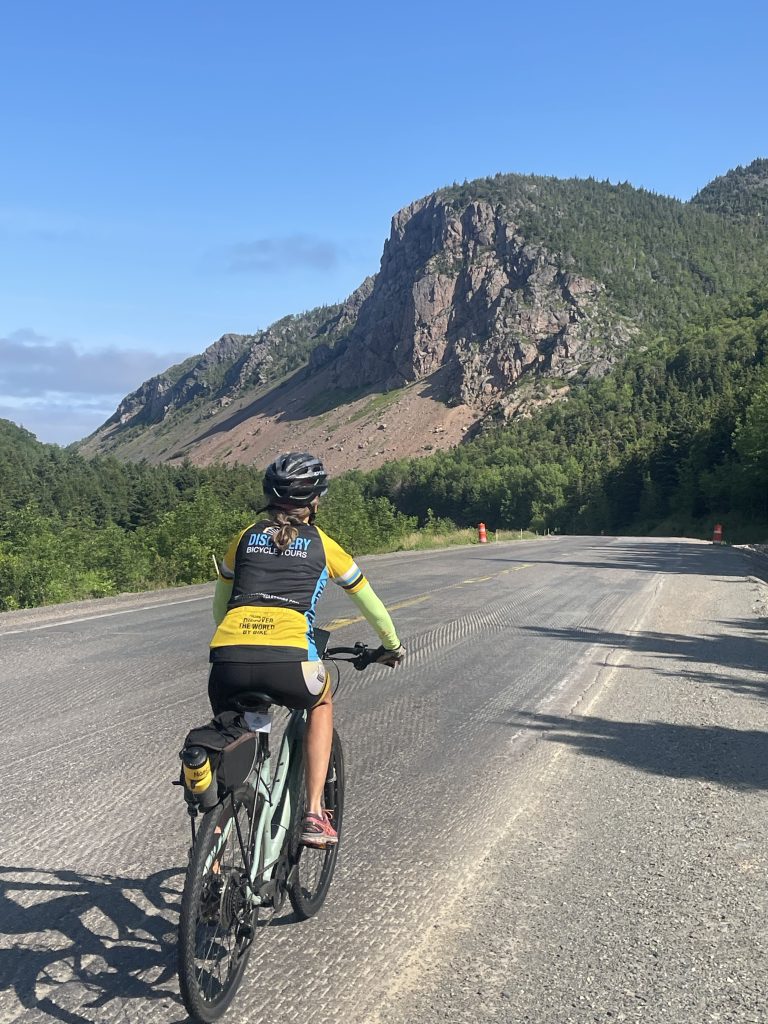
My plan worked. We signed up with Discovery Cycling Tours to cycle the Cabot Trail on Cape Breton Island. The trip information beckoned: “Experience the Cabot Trail’s legendary climbs.” Miss Nancy expressed some concern over that line. Admittedly I felt a twinge of “yikes” but kept my concern to myself.
Two years ago Miss Nancy had been inflicted with Lyme’s disease and it had almost crippled her in her knee. She still experiences some slight pain so I was glad she decided to choose an electric-assist bike rather than a pedal or analogue bike.
We went an extra week earlier to take in the sights including one of the best known Nova Scotia music fests, The Stan Rogers Folk Music Festival, also known as StanFest.
The late Stan Rogers is held almost mythically in these parts. He is also a favorite of Nancy’s and mine. His song Northwest Passage is viewed by many Canadians as an anthem and we heard it several times performed by different musicians.
Finally our group of cycling companions converged and we traveled north from Halifax by van to our starting point on Cape Breton Island.
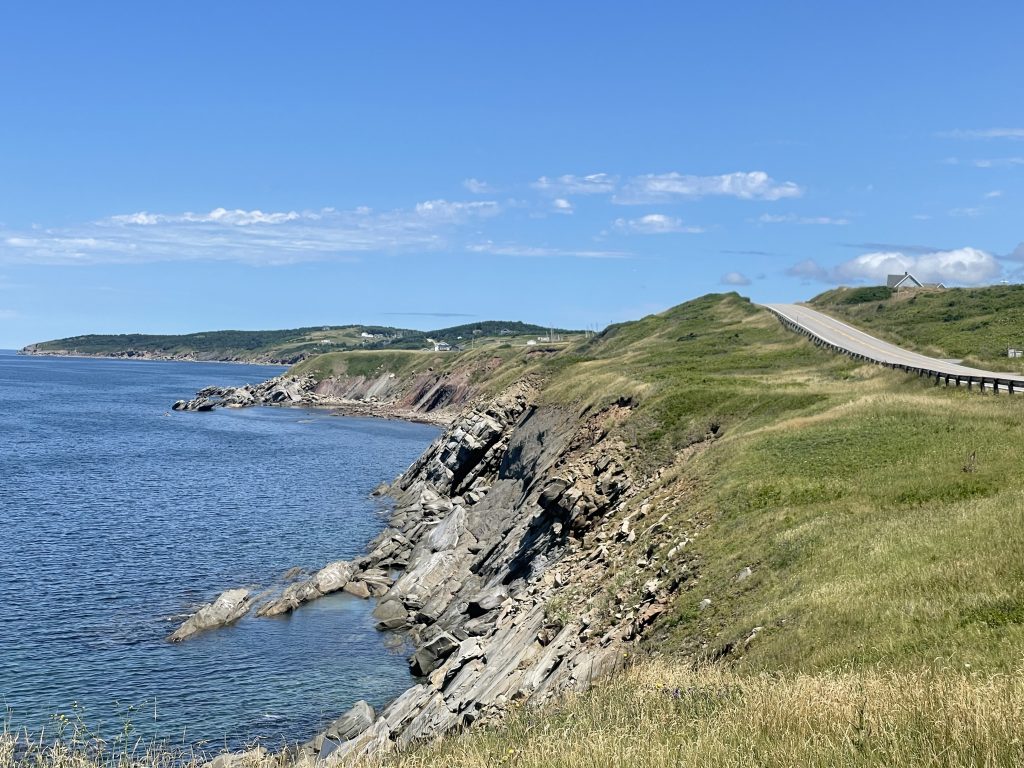
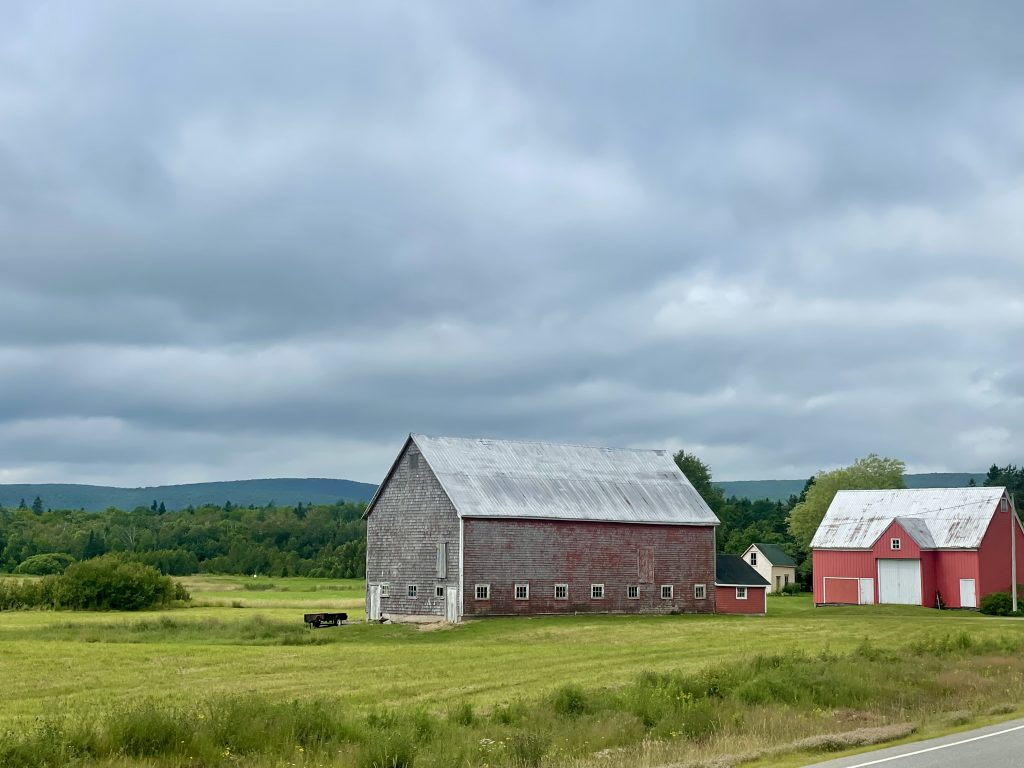
The first two days had us cycling past numerous pastoral farms, a trail of old steepled churches of various denominations and expanses of spectacular rugged coastlines. I was also struck by how undulating the Cabot Trail was with plenty of oxygen-sucking climbs.
On our second night Nancy got the opportunity to play a borrowed fiddle to accompany a professional Cape Breton musician.
Before the trip I was sort of dreading day four. I knew we had to face two major climbs on this day. And on top of it this was our longest cycling day of the trip: fifty miles. Now that I am seventy five years old, whether I am cycling, cross country skiing or backpacking, I have come to know that I relish a day off after a couple of extended workout days. Admittedly, this tour ride was no race and the guides always reminded us to have a relaxed, enjoyable tour. “Remember this is your vacation!”
After dinner, on the eve of our big cycling day where we would gain 4,700 feet in elevation, guide Mark asked for our attention. He wanted to give us a rundown on what to expect the following day.
I squirmed when Tom, the older guide, spoke up. He generally bears an almost mischievous smile overseen by a decidedly Irish twinkle in his eyes. He is a seasoned bike mechanic and has twice won the Nova Scotia mountain bike championship for his age group.
Tom’s face turned more sober when he shared his experience with the two testy climbs we would encounter.
“French Mountain, our first big climb of the day, is a serious three and a half miles of non-stop pedaling. There are no. . . zero. . . breaks on a 8 to 10% average gradient. And there are sections where the gradient is right around 16%. For perspective, we had a European cyclist in our group one year who had cycled both Mont Blanc and Alpe d’Huez. Both of those famed Alps climbs average a 6-8 % gradient. He claimed climbing French Mountain was much tougher.”
Our table got much quieter. Tom continued, “Those of you riding e-assist bikes need to be aware of how much power you have in your bike batteries. Those of you who on analogue, I will be sitting with the trailer in the trailhead parking lot at the base of the mountain for half an hour. If you find it too difficult, please turn around, glide back down and I will put your bike on the trailer and you can ride an e-bike up. Remember this is your vacation.”
From day one, I had often found myself pedaling with two Pennsylvania friends, Will and Bob. Bob was a determined beast on a bike but he was admittedly only 66 years old. Will was very steady and determined and he and I started up French together with Bob ahead of us.
We had climbed perhaps 300 meters when Will turned and between breaths huffed over his shoulder, “Don’t worry it’s going to get worse before it gets a lot worse.”
In a lovely synchronized turn we turned our bikes and shot down the grade back to Tom to switch out for the electric assist bikes. After a short lesson on how to use them, we returned to the climb.
After that big day, our evening feast took on a more celebratory nature. There was lobster and seafood to eat, the brisk waters of the Atlantic to dip into to soothe our leg muscles. Smiles continued to be rampant and soon we had to bid farewell to our gang.
For two days after returning to Minnesota, my thighs ached. I soothed myself by reminding myself that the souvenirs of soreness were so worth it in the beauty and companionship I experienced from fellow cyclists and the friendly folks of Nova Scotia.
Leave a Reply
You must be logged in to post a comment.